When removing a tree is the right call
Tree removal in Brisbane is usually the last option, not the first. A healthy tree shades the house through a long summer, soaks up storm water and holds clay banks together. But some trees reach a point where pruning will not fix the problem, and removal is the safer and more honest answer.
The common reasons are:
- The tree is dead or dying. Dead eucalypts drop limbs without warning, and dead wood becomes brittle in a few months of Queensland sun.
- It has been damaged in a storm. Split trunks, torn-out limbs and trees that have started to lean after a big blow rarely recover safely.
- The roots are causing damage. Figs, camphor laurels and umbrella trees planted close to the house can lift paths and slabs and find their way into old clay pipes.
- It is in the wrong place. Over the roof, under the power line, on the line of a new extension, pool or driveway.
- It is a declared weed. Camphor laurel, Chinese elm, broad-leaved pepper tree and African tulip tree are all restricted invasive plants in Queensland. You are generally not required to remove them, but many owners choose to.
If the tree is sound and simply too big, ask about pruning first. A good contractor will tell you if a reduction would solve the problem for less money.
How a tree is taken down
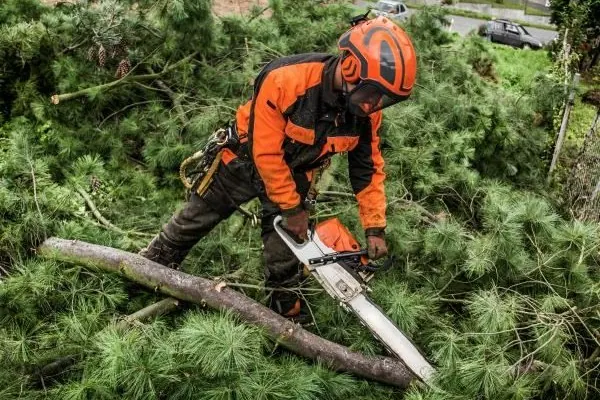
Very few suburban trees in Brisbane are felled in one piece. There is rarely room. Most are removed in sections.
Climbing and sectioning. The climber works up the tree on ropes, removes the limbs from the top down and lowers each piece to the ground on a rigging line. The trunk is then taken down in short lengths. This is slow and careful work, and it is how a large tree beside a Queenslander or over a pool comes out without touching either.
Elevated platforms and cranes. Where a truck can get close, an elevated work platform lets the crew cut from a basket rather than climbing. On big trees over houses, a crane can lift whole sections out over the roof. Both cost more per hour but can make a long job much shorter.
Felling. On acreage, or where there is a clear drop zone, a tree can be felled in one direction. It is quick, but it needs room the length of the tree plus a safety margin.
Brisbane conditions that change the job
- Wet clay. After a week of rain the ground under a tree can be soft enough to sink machinery. Some jobs wait for the ground to firm up, or use mats to spread the load.
- Sloping blocks. Inner suburbs like Ashgrove have steep yards and high-set houses, so timber often has to be carried uphill or lowered over retaining walls.
- Narrow access. Many older blocks have a single side path. A climbing crew and a small chipper can work with that. Big machinery cannot.
- Wildlife. Possums, birds and in some areas koalas use big trees. A careful contractor checks for nests and animals before cutting and pauses if one is present.
Council approval and koala mapping
Brisbane City Council's Natural Assets Local Law 2003 protects some trees on private land, including significant landscape trees and vegetation in certain mapped areas. Logan City Council, the City of Ipswich, the City of Moreton Bay and Redland City Council each manage vegetation through their own planning schemes and local laws. State koala habitat mapping also covers parts of south-east Queensland.
That does not mean you cannot remove a tree. It means someone needs to check before work starts. Ask the contractor to check the mapping as part of the quote, and if in doubt, call the council. Removing a protected tree without approval can bring fines and replanting orders, and that falls on the owner, not the contractor.
Street trees on the footpath belong to the council. Do not prune or remove them yourself; report problems to the council.
Trees on the boundary
If the tree is on your neighbour's land, or the trunk straddles the boundary, talk to them first. Queensland's Neighbourhood Disputes (Dividing Fences and Trees) Act 2011 sets out who is responsible for a tree and what happens if it causes damage, and QCAT can make orders where neighbours cannot agree. A shared quote is often the simplest way through.
What it costs
Prices depend on the size of the tree, how close it is to buildings and wires, access, and whether the stump and timber go too. Guide bands for 2026 are on the tree removal prices page. The only accurate number is the written one you get after someone has seen the tree.
After the tree is down
Once the tree is down you have three choices about what is left at ground level. You can leave the stump cut low and let it rot, have it ground below the surface, or have it dug out with its major roots if you are building. If the tree came down in a storm, the storm season checklist covers insurance photos and what to do while you wait.