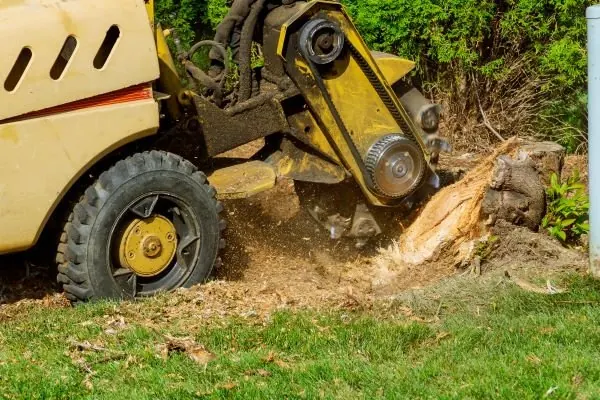
What stump grinding does
Stump grinding is the most common way to deal with a stump in a Brisbane backyard. A grinder has a heavy spinning wheel fitted with hardened teeth. The operator sweeps it across the stump, taking it down a few centimetres at a time, until the stump is below the surface. What is left is a hole full of wood chips and soil, with the old roots still in the ground to rot away naturally.
It is quicker, cheaper and much less disruptive than digging a stump out. For lawns, garden beds and play areas it is usually all you need. If a slab, pool or driveway is going over the spot, look at stump removal instead.
Reasons people grind stumps
- Mowing. A stump in the lawn is something to go around every week.
- Safety. Low stumps are easy to trip on, especially in long grass or at night.
- Termites and fungus. Rotting stumps can host termites and wood-decay fungi. Grinding does not guarantee a stump will not attract termites, but it removes the main food source above ground.
- Regrowth. Some trees sprout vigorously from a cut stump. Grinding removes the growing tissue.
- Looks. A stump left after a removal is a reminder of the tree, and most people want the space back.
Grinders and access
Grinders range from compact machines that fit through a standard side gate to large tracked or towed units for acreage and commercial sites. The bigger the machine, the faster it works, but it has to get to the stump.
On older Brisbane blocks the limiting factor is often the side path between the house and the fence. Highset Queenslanders sometimes have stairs or a steep path down to the yard. A compact grinder can handle most of these, but it takes longer on large stumps. When you ask for a quote, measure the narrowest point and mention any steps.
On acreage around Greenbank and Caboolture, larger machines can work through big eucalypt stumps much faster, which matters when there are several to do.
Before the grinder starts
Grinding throws chips and stones, so the operator will check what is nearby: windows, cars, pool fencing, glass doors. Underground services near the stump matter too, because some grinders reach well below the surface and roots often wrap around old pipes. Mention any irrigation lines, garden lighting cables or pipes you know about.
Wet clay can make the work messy and slow, and a heavy machine on saturated lawn leaves ruts. After heavy rain, a contractor may suggest waiting a few dry days.
After grinding
The hole will be full of chips mixed with soil, slightly mounded at first. Over months it settles as the chips break down. For turf, many people remove some of the chips and top up with soil before laying. For a garden bed, the chips can be dug in, but add some nitrogen-rich fertiliser because breaking-down wood ties up nitrogen.
Shoots coming up from the old roots should be cut off as soon as they appear. Camphor laurel and umbrella tree are the usual offenders in Brisbane.
Grinding with a tree removal
If the tree is still standing, have the grinding quoted with the tree removal. The crew is already there and the price is usually better than booking the stump separately later. If you have several old stumps, have them all quoted at once; the set-up cost is shared.
Price
Grinding is usually priced by stump size and number, adjusted for access and what happens to the chips. Guide bands are on the prices page. A photo with something for scale and the gate width will get you a closer answer, and a site visit gets you a firm one.